

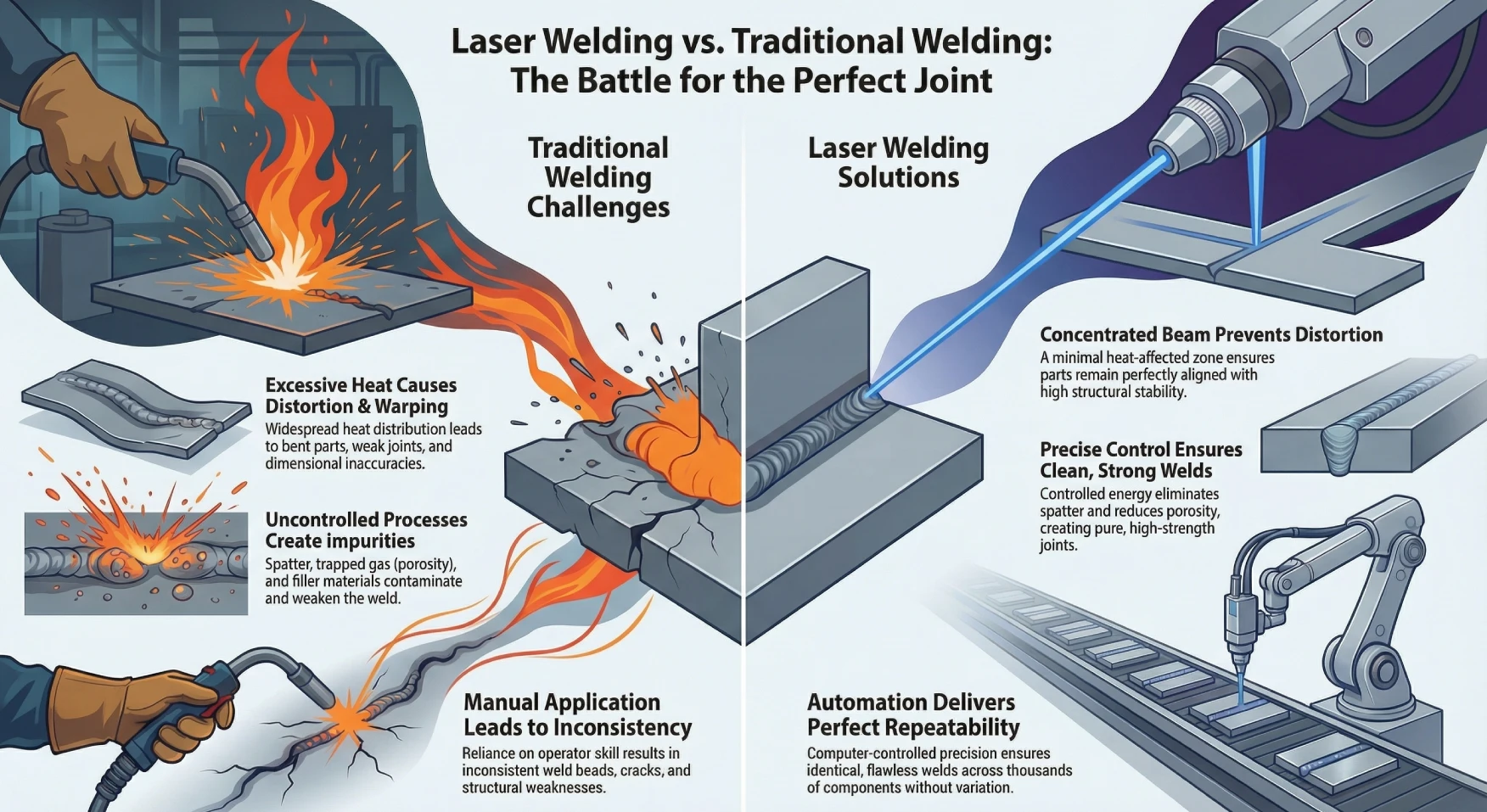
Modern manufacturing requires welding processes that deliver high strength, accuracy, consistency, and visual perfection. Traditional welding methods—such as TIG, MIG, and arc welding—have served industries well for decades, but they also come with challenges such as distortion, spatter, porosity, cracks, heat-affected zones, and inconsistent joints.
To overcome these limitations, industries across automotive, aerospace, fabrication, EV battery production, and electronics are adopting laser welding machines. Known for their precision, minimal heat input, and superior control, laser welding systems deliver flawless welds with significantly fewer defects.
This blog explores how laser welding machines reduce common welding errors and dramatically improve joint quality—resulting in stronger, cleaner, and longer-lasting welded components.
1. Highly Concentrated Heat = Fewer Distortions
One of the biggest problems with traditional welding is excessive heat distribution, which causes:
- Warping
- Bending
- Loss of dimensional accuracy
- Weak weld joints
Laser welding machines work with a highly concentrated laser beam that only heats a very small area. This results in:
✔ Minimal heat-affected zone (HAZ)
✔ Reduced distortion of surrounding metal
✔ Perfectly aligned joints
✔ Higher structural stability
The precise energy input ensures that even thin sheets and delicate parts can be welded without deformation.
2. Ultra-Low Spatter for Cleaner Welds
Spatter is a common defect in MIG/TIG welding due to uncontrolled melting and metal displacement. Laser welding eliminates this issue through:
- Controlled laser beam intensity
- Optimized melt pool stabilization
- Accurate beam focus
- Smooth energy distribution
This ensures:
✔ Spatter-free welds
✔ Zero contamination
✔ Reduced finishing work
✔ Clean and aesthetic seams
Industries like EV battery manufacturing and electronics rely heavily on this feature.
3. Narrow and Uniform Weld Beads
Laser welding produces extremely narrow, deep, and uniform weld beads because the beam is precisely focused. This improves:
- Joint strength
- Mechanical integrity
- Fatigue resistance
- Visual appearance
Unlike conventional welding, which may leave inconsistent bead shapes, laser welding ensures the same weld profile across thousands of components—making it ideal for mass production.
4. Reduced Porosity for Stronger Joints
Porosity occurs when trapped gas bubbles form inside the weld metal, weakening the joint. Laser welding reduces porosity by:
- Rapid melting and solidification
- Stable, controlled energy input
- Reduced oxidation due to shielding gases
- Clean welding surfaces
This leads to:
✔ Stronger joints
✔ Higher load-bearing capacity
✔ Longer component lifespan
Industries requiring critical structural performance—such as aerospace and medical—prefer laser welding for this reason.
5. Precise Penetration Control Eliminates Under- or Over-Welding
Traditional welding often results in:
- Shallow penetration (weak joints)
- Excessive penetration (burn-through)
Laser welding machines, however, offer:
✔ Real-time penetration control
✔ High-precision beam modulation
✔ Variable focus adjustment
✔ Monitoring systems for depth consistency
This ensures:
✔ Perfect weld depth
✔ Strong joints
✔ Zero burn-through
✔ Reliable welding for thin or mixed materials
Automotive and EV battery pack manufacturers use laser welding for parts requiring extremely controlled penetration values.
6. Ideal for Welding Dissimilar Metals
Traditional welding struggles when joining metals with different melting points—such as:
- Copper + Aluminum
- Stainless Steel + Mild Steel
- Titanium + Nickel alloys
Laser welding easily handles such combinations due to:
✔ Controlled heat input
✔ High-speed joining
✔ Localized melting
✔ Stable fusion zone
This allows industries to design lighter, stronger, and more efficient products.
7. Eliminates Excessive Filler Material and Reduces Impurities
Laser welding often requires no filler material, which results in:
- Cleaner welds
- Less contamination
- Fewer defects
- Better surface quality
Since filler metals introduce impurities and inconsistencies, avoiding them helps achieve superior metallurgical bonding.
8. Improved Repeatability for Mass Production
Manual welding heavily depends on operator skill, making consistency a major challenge. Laser welding machines offer:
- Computer-controlled precision
- Automated welding paths
- Robotic compatibility
- Repeatable weld parameters
This ensures:
✔ Identical weld quality across every batch
✔ Zero operator dependency
✔ No variation in joint strength
Perfect for industries running large production volumes.
9. Minimizes Cracks and Microstructural Weakness
Cracks occur when excessive thermal stress is introduced during welding. Laser welding prevents cracking by:
✔ Rapid heating and cooling
✔ Minimal stress on surrounding material
✔ Reduced thermal cycling
✔ Narrow fusion zone
Because the heat footprint is smaller, the risk of hot cracks, cold cracks, and micro-fractures is significantly reduced.
10. Enhances Aesthetic Quality of Welds
Many industries—especially appliance, architecture, automotive, and stainless-steel fabricators—prefer laser welding because it produces:
- Smooth weld lines
- Perfect seams
- Zero or minimal grinding requirements
- Visually appealing finishes
This dramatically reduces post-weld finishing time, saving cost and effort.
11. Cleaner Welding Environment
Laser welding produces:
✔ Less smoke
✔ Minimal spatter
✔ Fewer fumes
✔ No sparks
This reduces defects caused by contamination and allows for safer working conditions.
Conclusion: Laser Welding Is Transforming Modern Manufacturing
By minimizing defects and delivering exceptional joint quality, laser welding machines have become indispensable in advanced manufacturing. Their ability to offer:
- High precision
- Deep penetration
- Consistent welds
- Low heat distortion
- Clean and aesthetic results
makes laser welding the preferred method across industries.
Traditional welding cannot match the accuracy, speed, or metallurgical strength that laser welding provides. As industries demand higher productivity and reliability, laser welding machines will continue replacing conventional systems.
If you’re evaluating welding technologies, remember:
✔ Laser welding enhances quality
✔ Laser welding reduces waste
✔ Laser welding increases efficiency
✔ Laser welding provides long-term cost savings
Laser welding isn’t just an upgrade—it’s the future of professional metal joining.



Leave a Reply